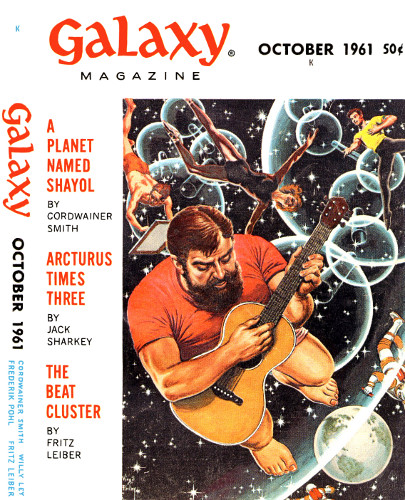
ARCTURUS TIMES THREE
By JACK SHARKEY
Illustrated by SCHELLING
[Transcriber's Note: This etext was produced from
Galaxy Magazine October 1961.
Extensive research did not uncover any evidence that
the U.S. copyright on this publication was renewed.]
A man who lived three lives? A piker! Jerry
Norcriss lived hundreds—all over the Galaxy!
ZOOLOGY 2097
Trial-and-error familiarization with new life-forms is dangerouslyimpractical on a far planet, where the representation of Earth menmay be a solitary five-man crew. The loss of even a single manconstitutes, in effect, obliteration of one-fifth of that planet'sEarth-population. This is the "why" of the Space Zoologist.
The science of Contact came into being as a result of agovernment-subsidized "crash" program in the early seventies,following on the heels of the disastrous second Mars landing.
The first flight to Mars had been simple in intent. The job of themen on board had been merely to land in one piece and radio thejoyous news back to Earth, to take some samplings of soil and air,some photographs and then return to Earth. All this was accomplishedwithout incident.
It was the second Mars landing that occasioned the discovery of thequilties. These furry beasts, somewhere between marmosets and koalasin appearance save for overall bright orange and green tangles offur, were found to be friendly, and unanimously adopted by the crewmembers as mascots and pets. The animals, disarmingly akin to ambulantrag-toys cut from patchwork counterpanes, did indeed deserve thenickname of "quilties". They were cuddly, friendly, with sad eyes andmournful squeaky voices that endeared them to all the men on thatflight.
Fortunately, their discovery was radioed back to Earth along with theusual information in that first day's report. There were no subsequentmessages.
Mars Flight Three found the remains of the crew where the quilties hadleft them.
On investigation by the ship's doctor, it was found that the biologyof the quilty was similar to that of a hornet, and they consideredman—as they would anything warm and fleshy—in the relative positionof a caterpillar. During the cuddling with the small beasts, minutehairlike spines at the base of the quilties' tails had managed toprick the flesh of the crewmen. By the following morning, the menhad been eaten to death from within by the grubs of gestating babyquilties.
All of this, of course, is common knowledge today. But it is mentionedhere solely to demonstrate to you the monumental hazards which anastronaut had to encounter in the days before the discovery ofContact, and the development of the Space Zoologist, without whosetraining, courage and efforts extra-Terran colonization would be nextto impossible.
"CONTACT—Its Application and
Indigenous Hazards"
by Lt. Commander Lloyd Rayburn,
U. S. Naval Space Corps
Lieutenant Jerry Norcriss stood at the edge of the wide green clearing,sniffing contentedly of the not-unpleasant air of Arcturus Beta. Threehundred yards behind him, crewmen and officers alike labored to unloadthe equipment necessary for setting up camp for this, their first nighton the planet.
No one had asked him to lend his strong back to the proceedings. SpaceZoologists were never required to do anything which might sap, evenslightly, any of their physical energies. Moreover, they were underoath not to take any orders to the